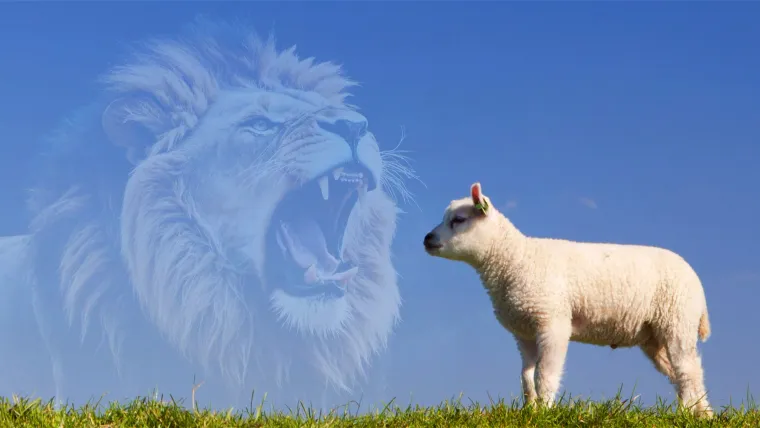
If you attend a UK church service this Easter, the chances are high you'll sing about Jesus being a lion. This is because the lyrics of the 3rd (Living Hope by Phil Wickham, Brian Johnson), 11th (How Great is our God by Chris Tomlin, Ed Cash, Jesse Reeves), and 35th (The Lion and the Lamb by Brenton Brown, Brian Johnson, Leeland Mooring) most popular worship songs in the UK at the moment, according to Christian Copyright License International (CCLI), all do so.
Living Hope is just as popular in Canada (2nd), the US (4th), and Australia (11th) as it is in the UK (3rd). Each time churches sing this song, we declare that the resurrected Jesus is a "roaring lion" who announces his victory over the grave.
How has this worship song gained such popularity in the Church when there's only one roaring lion in the New Testament, and it isn't Jesus?
Be sober, be vigilant; because your adversary the devil walks about like a roaring lion, seeking whom he may devour.
— 1 Peter 5:8 NKJV (emphasis mine)
Lions are rising in popularity
The New Testament only links Jesus once with a lion, in Revelation 5:5. Yet, despite this single reference, there's a growing trend within churches over the last two decades to praise Jesus as both lamb and lion.
But one of the twenty-four elders said to me, "Stop weeping! Look, the Lion of the tribe of Judah, the heir to David's throne, has won the victory. He is worthy to open the scroll and its seven seals."
— Revelation 5:5 NLT (emphasis mine)
A literal reading of this verse and of Revelation as a whole is to blame, but so is the popularity of worship songs that proclaim this idea. Here, I think of How Great is our God by Chris Tomlin—written in 2004, but still one of the most sung worship songs in Canada (9th), the UK (11th), the US (15th), and Australia (21st)—is normalising this way of thinking.
On praisecharts.com, I found a list of 150 worship songs that associate Jesus with the Lion of Judah (though some simply mention lions). They introduce this list by saying, "Jesus Christ, as the Lion, conquered sin and death..."
Does that sound right to you?
Is this good theology?
I looked up the lyrics of the top twenty-or-so songs they list and found eight recently released worship songs embracing the idea of Jesus dying as a lamb and rising as a lion.
- Living Hope by Phil Wickham, Brian Johnson (2018)
- Is He Worthy by Andrew Peterson, Ben Shive (2018)
- Ain't No Grave by Jonathan David Helser, Melissa Phillips Hesler, Molly Kate Skaggs (2019)
- Turn Your Eyes by George Romanacce, Kevin Winebarger, Nathan Stiff, and Nic Trout (2019)
- Lion by Brandon Lake, Chris Brown, Steven Furtick (2022)
- No Body by Brett Younker, Jason Ingram, Pat Barrett, Steven Furtick (2023)
- I Believe by Jonathan Smith, Phil Wickham, Christopher Michael Davenport (2023)
- Marvellous by Bethel Music, Hannah Waters (2025)
The symbology of lions
These new worship songs are using lion metaphors to praise Jesus for his victory over sin and death, yet we know from exploring the use of Lions in Scripture last week that when Biblical authors associate lions with God, leaders, or nations, they are almost always doing so negatively.
Lions ambush, they devour, they tear apart, they prowl.
They are not a symbol of victory, but a symbol of overwhelming destructive power. Lions are one of the most violent metaphors the Bible uses.
So why then does Revelation refer to Jesus as "the Lion of the tribe of Judah?"
Revelation 4
Before we rush into Revelation 5, it's important to set it within the context of the chapter before, simply because the events of Revelation 4 flow into that of 5.
The message to the assembly in Laodicea ended with Jesus knocking on a closed door and promising the "victorious will sit with me on my throne, just as I was victorious and sat with my Father on his throne" (Rev. 3:21 NLT). John's next vision then begins with an open door in heaven and an invitation from Jesus to "Come up here" (Rev. 4:1) to see his Father sitting on his throne.
John describes God by not describing him, as is the norm in the Bible.
The one sitting on the throne was as brilliant as gemstones-like jasper and carnelian. And the glow of an emerald circled his throne like a rainbow.
— Revelation 4:3 NLT
The gemstones John mentions are the last and first ones attached to the chest-piece of the high priest in Exodus 28:17-20. While the rainbow reminds us of God's "eternal covenant between God and every living creature on earth" in Genesis 9:16 to deal with sin through relationship rather than violence. John is setting up a theme of nonviolence here ahead of the violent visions to come.
The throne room itself (as well as the four living creatures) is a mashup of heavenly court imagery from Scripture (primarily, from the Ezekiel 1, Isaiah 6, and Daniel 7), with a unique political twist that evokes the Roman senate by positioning twenty-four thrones around God's central one (see Rev. 4:4).
In Rome, the emperor's throne was placed in the middle of the room, with the chairs of the senators arranged around it in a semicircle.
— Robyn J. Whitaker
Revelation for Normal People, p.36
Twenty-four elders sit upon these thrones like senators in God's presence. These elders are "all clothed in white and had gold crowns on their heads" (Rev. 4:4 NLT). Not only does this imagery link back to the promises to Sardis (of white robes in 3:5), Philadelphia (of crowns in 3:11), and Laodicea (of thrones in 3:21), it again points to Roman practices when these elders worship God by laying down their crowns before him (in Rev.4:10).
Roman senators wore white togas. Dio Cassius, [a] Roman historian, describes them with crowns that they threw to the ground as they bowed before the emperor in worship.
— Robyn J. Whitaker
Revelation for Normal People, p.36
John isn't simply making theological statements; he's making political ones too.
Seeing takes precedence
Revelation 5 continues the vision with John saying he saw "a scroll in the right hand of the one who was sitting on the throne" (Rev. 5:1 NLT). Writing covers both sides of this scroll and it’s "sealed with seven seals" (Rev. 5:2). Considering that Revelation 4 ended with the twenty-four elders worshipping God for creating all things, this scroll likely contains God's plan for the healing of creation.
When an angel asks if anyone is worthy to open it, John ends up weeping because no one in creation is found to do so (Rev. 5:3-4).
Which brings us to the lion verse. We find the interpretive key for Revelation 5:5 at the very beginning of John's vision.
I was in the Spirit on the Lord's day, and I heard a loud voice behind me like a trumpet saying, "Write on a scroll what you see and send it to the seven churches..."
— Revelation 1:10-11 CSB (emphasis mine)
John is told to write in a book everything he sees. Unlike many other prophecies in the Bible, seeing takes precedence over hearing in Revelation.
"Then I saw" (Rev. 5:1).
"And I saw" (Rev. 5:2).
"Then I saw" (Rev. 5:6).
"Then I looked again" (Rev. 5:11).
And what does the elder tell John to do in verse 5, other than stop weeping?
He tells him to look!
But one of the twenty-four elders said to me, "Stop weeping! Look, the Lion of the tribe of Judah, the heir to David's throne, has won the victory. He is worthy to open the scroll and its seven seals."
— Revelation 5:5 NLT (emphasis mine)
If someone announces that a lion stands in front of you, what would you expect to see when you look up? A lion, right? Or, if not a lion, a lion of a man. Someone physically imposing. Perhaps a great conqueror or warrior in the ilk of Alexander the Great.
And what does John see?
John wipes away his tears and looks, and what does he see?
Then I saw a Lamb, looking as if it had been slain, standing at the centre of the throne, encircled by the four living creatures and the elders. The Lamb had seven horns and seven eyes, which are the seven spirits of God sent out into all the earth.
— Revelation 5:6 NIV (emphasis mine)
He sees a lamb.
A lamb that died violently, yet stands alive next to the throne in the centre of the room. It’s important to state, considering the worship songs being released, that Jesus' resurrection doesn't magically transform him from a self-sacrificing lamb to an all-conquering lion. Jesus dies as a lamb and rises as a lamb.
John doesn't see a god who tears others to pieces in order to triumph—like human empires would—he instead sees a God who allows himself to be torn to pieces to become victorious.
There is no lion, for the Lion of Judah and the Lamb are opposites.
Heaven only worships the lamb
How do we know this is the way to understand this vision? The three scenes of worship that follow Jesus taking the scroll give us our answer.
The four living creatures and the twenty-four elders sing a new song:
"You are worthy to take the scroll and to open its seals, for you were slaughtered and by your blood you ransomed for God saints from every tribe and language and people and nation; you have made them to be a kingdom and priests serving our God, and they will reign on earth."
— Revelation 5:9-10 NRSV
Jesus' worthiness is based upon his willingness to be "slaughtered." It's his self-sacrifice that releases captives. Only his actions as a lamb are praised here.
Thousands and millions of angels then sing:
"Worthy is the Lamb that was slaughtered
to receive power and wealth and wisdom and might
and honor and glory and blessing!"
— Revelation 5:12 NRSV
Again, it is "the Lamb that was slaughtered" who is worshipped. Again, there's no mention of a lion.
Then "every creature in heaven and on earth and under the earth and in the sea" (Rev. 5:13) sings:
"To the one seated on the throne and to the Lamb
be blessing and honor and glory and might
forever and ever!"
— Extract from Revelation 5:13 NRSV
Despite naming Jesus as "the Lion of the tribe of Judah" (Rev. 5:5), every heavenly and earthly creature ignores that title in their worship of him. They only worship "the one seated on the throne" and "the Lamb." If John was promoting Jesus as a lion or rising as a lion, then surely these brief scenes of worship would include references to that effect. But they do not. This is the first and last time Jesus is called a lion, but he is called a Lamb another twenty-seven times in Revelation.
Jesus is never worshipped as a lion in Revelation or in the wider New Testament.
I believe this sets the precedent for us never worshipping Jesus as a lion. Bowing down to one precludes us from bowing down to the other.
Why is Jesus given this title?
So why does one of the twenty-four elders announce Jesus as "the Lion of the tribe of Judah," and "the heir to David's throne" who "has won the victory" (Rev. 5:5 NLT)?
The one-word answer is: expectation.
People believe violence overcomes violence, and more powerful empires conquer previously all-conquering empires. The elder’s titles for Jesus echo the persistent militaristic expectation for a messianic king who would liberate God’s people from six continuous centuries of oppression by the Babylonians, Persians, Greeks, and now the Romans.
This expectation is what John hears. One has been found, a great king, a mighty warrior... However, the fact that only one has been found should tip us off that this one is different than what most of us expect.
— Ted Grimsrud
To Follow the Lamb, p.68
The elder affirms Jesus is the triumphant Messiah by using two titles that allude to messianic prophecy in the Old Testament (see Gen. 49:10 and Isa. 11). Yet, when John looks at this Messiah, he sees something shocking: a risen lamb who triumphs by dying at the hands of empire.
Jesus allows himself to be slain rather than slaying his enemies in order to redeem his people. With this single image of a slain lamb alive forever, John undoes our expectation of what it means to conquer. He confounds the violent imagery that these two titles conjure by reimagining victory arriving through the self-sacrificial suffering of love.
The reason John refers to Jesus as a lion is to undo the idea of Jesus as a lion.
John turns lion-power into lamb-power. He transforms the lion into a lamb, and not the other way around, like some of our worship songs suggest. This leaves us with a choice of whom we worship: the Lion or the Lamb.
And, according to John, only the lamb who was slain is worthy of our worship.